If you want a wearable that tells you how far you ran, shows your texts, and replaces your phone on your wrist, WHOOP is probably not your best fit. But if you want a wearable focused on recovery, sleep, training load, and habit change, it still stands out in a crowded category.
In this review, the real question is not whether WHOOP works. It does. The better question is whether its coaching-first, membership-based model gives you enough value to justify the cost.
That matters more now because WHOOP is no longer just one device. As of 2026, WHOOP’s lineup is split across One, Peak, and Life memberships. Both One and Peak include the WHOOP 5.0 hardware; the main difference is that Peak offers more advanced analytics and coaching features. Life includes WHOOP MG, which provides the most premium experience.
To make comparison easier: One covers essential fitness and recovery tracking, including sleep, strain, and daily readiness. Peak adds features like Healthspan and Health Monitor, advanced training analytics, and stress tracking tools. Life includes everything in Peak plus WHOOP MG with ECG, on-demand AFib detection, and Blood Pressure Insights (currently in beta), for users seeking the most in-depth health information.
Annual pricing currently starts at $199 for One, $239 for Peak, and $359 for Life. WHOOP also offers a one-month free trial with a certified pre-owned WHOOP 5.0 device.
For athletes most likely to consider it, the appeal is clear. If you are plateauing despite consistent training, struggling with nagging fatigue, or trying to reduce guesswork around recovery, WHOOP aims to answer a simple question: “How ready is my body today?”
Introduction
WHOOP’s biggest differentiator is that it is built around behavior change, not just data collection. The platform centers on Sleep, Strain, Recovery, stress, and coaching, turning continuous biometric tracking into daily recommendations. WHOOP describes the system as a 24/7 wearable-and-app experience designed to help users sleep better, train smarter, and improve long-term health, rather than simply counting steps or displaying notifications.
That makes WHOOP especially appealing for recreational athletes, endurance-focused users, and serious gym-goers who feel stuck. Many wearables are good at collecting data. Fewer are good at turning those numbers into decisions. WHOOP tries to do the latter.
Still, there are tradeoffs. WHOOP is screen-free, relies on your phone for route tracking, and uses a subscription model rather than a one-time hardware purchase. WHOOP’s support pages state the sensor does not have built-in GPS, and the brand embraces a zero-distractions screen-free design. For GPS and route tracking, WHOOP pairs with your smartphone to record distance and routes using your phone’s GPS during activities. However, live pace, mapping, and navigation are accessible only through the phone, not on the WHOOP band. This means runners and cyclists wanting on-the-go wrist tracking still need to bring their phone or use a separate GPS watch for real-time data.
Features Overview
Sleep, recovery, and strain
This is the core of the WHOOP experience.
WHOOP tracks sleep stages and estimates your nightly sleep need based on recent patterns, daily strain, sleep debt, and naps. It then recommends optimal bedtime and wake times. Recovery shows your readiness to perform. Strain is a 0–21 score of cardiovascular and muscular exertion.
For real-world training, this matters more than it sounds. If your recovery is low, WHOOP nudges you toward a lighter day. If your recovery is high, it signals a green light to push harder. For athletes who overdo intensity or underestimate poor sleep’s impact, that guidance can be more useful than another watch face full of metrics.
Coaching and behavior tracking
WHOOP has become more helpful as its coaching features have expanded.
The platform offers personalized coaching, an AI-powered Coach, and a Journal for logging over 300 daily behaviors to track how choices affect recovery and performance. WHOOP says the Coach analyzes biometric trends and context, such as location and weather, to provide real-time guidance on training, recovery, and sleep.
This is where WHOOP addresses common pain points for athletes. If you train hard but do not improve, the issue may not be your programming. It might be poor sleep consistency, alcohol, travel stress, under-fueling, or accumulating more fatigue than you realize. WHOOP helps uncover those patterns.
That said, it is not a replacement for a skilled coach, sports dietitian, or personalized nutrition and supplement planning. It can reveal habits that hurt recovery but cannot fully design your performance strategy.
Strength and muscular load features
WHOOP used to be seen mainly as an endurance-focused tool, but it is now more useful for lifters than ever before.
WHOOP’s Strain model measures cardiovascular and muscular load. Its Strength Trainer combines sensor data with logged workouts to better estimate lifting stress and provide a fuller picture for strength training, HIIT, and similar sessions.
That is a meaningful improvement for strength and power athletes. Heavy lifting does not always show up well in heart-rate-driven strain alone, so adding muscular load makes WHOOP more relevant for CrossFit athletes, bodybuilders, and powerlifters.
Hardware and wearability
WHOOP memberships focus on WHOOP 5.0 and WHOOP MG. Both offer 14+ day battery life and emphasize a screen-free, 24/7 wearable design, including flexible off-wrist options with WHOOP Body apparel.
That hardware philosophy remains one of WHOOP’s best strengths. It is discreet, comfortable, and easy to wear continuously, essential for any device focused on recovery trends rather than glanceable notifications.
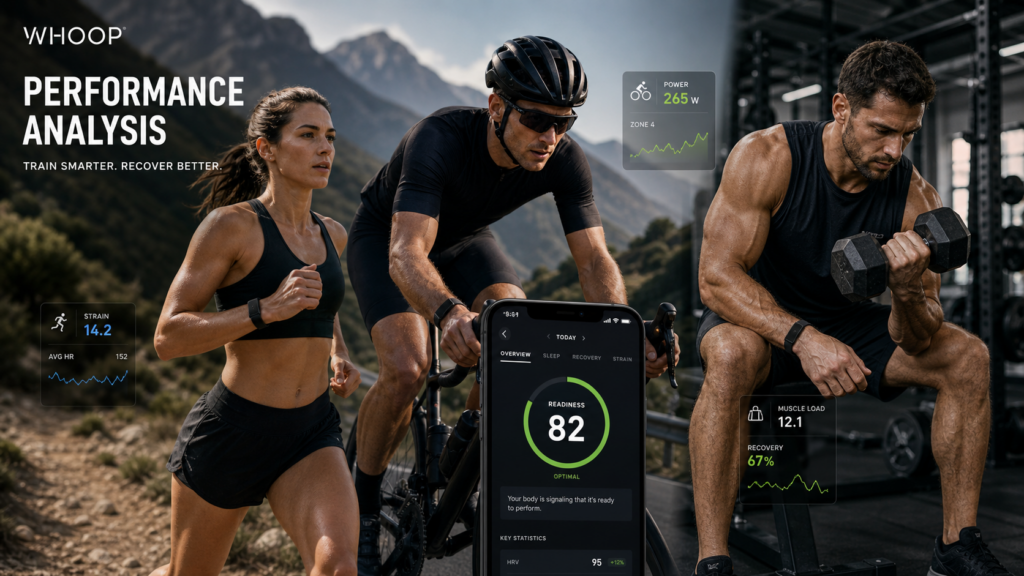
Performance Analysis
For amateur and recreational athletes
WHOOP is arguably most valuable for the person who trains consistently but does not always recover intelligently.
If you are the classic weekend warrior doing early runs, lifting after work, and trying to squeeze performance gains from a busy schedule, WHOOP’s sleep and recovery guidance can be a reality check. It helps you see whether your body is adapting to your workload or just surviving it.
This is also where the platform’s journal and coaching tools matter. Small habits add up fast for recreational athletes: late nights, missed meals, inconsistent sleep, alcohol, and stress can quietly stall progress for months. WHOOP excels when it turns those invisible problems into visible patterns.
For endurance athletes
Endurance athletes are still one of WHOOP’s strongest use cases.
Runners, cyclists, triathletes, and hybrid athletes often benefit most from the recovery-strain relationship because their training load is frequent, cumulative, and sensitive to sleep and fatigue. WHOOP’s platform connects those dots: how much strain you accumulated, how well you recovered, how much sleep you need, and how hard you should push next.
The biggest limitation is route tracking. WHOOP lacks built-in GPS, so if live pace, mapping, and navigation are central to your training, you may want a dedicated sports watch. Many endurance athletes get the most value by pairing WHOOP with another device rather than using it as a one-device solution.
For strength and power athletes
WHOOP is more useful for lifters than some critics claim, but you need the right expectations.
Its real value for strength athletes is monitoring readiness, sleep, stress, and total load over time, not perfectly capturing every nuance of muscle damage or CNS fatigue. Adding muscular load and Strength Trainer makes the platform better suited to lifting than older versions, but it still shines more as a recovery-management tool than a pure lifting-performance tracker.
So if you are a gym-focused athlete, WHOOP can help answer questions like:
- Am I recovered enough to push intensity today?
- Is poor sleep killing my training quality?
- Are my lifestyle habits creating fatigue that I keep blaming on programming?
Those are valuable answers, especially for athletes dealing with recurring soreness, slow recovery, or inconsistent performance.
Accuracy and limitations
No wearable gets a free pass on accuracy, and WHOOP is no exception.
WHOOP’s support materials note that accuracy is affected by device fit and placement, recommending a snug fit about 1 inch above the wrist bone. It also supports alternative wear locations and automatically detects sleep and activity for easier passive tracking.
In practice, WHOOP is best judged as a trend tool, not a perfect second-by-second sports instrument. It is useful for watching recovery patterns, sleep quality, and training load over time. It is less ideal if your top priority is ultra-precise live workout feedback without using your phone.
Pros and Cons
Pros
- Excellent focus on sleep, recovery, and readiness
- Strong behavior-change tools through coaching and journaling
- More useful for lifters now, thanks to muscular load and Strength Trainer
- Comfortable screen-free design works well for 24/7 wear.
- Better long-term training context than many mainstream fitness trackers
- The current lineup offers a free-trial path for cautious buyers.
Cons
- Subscription model will be a dealbreaker for some users.
- No built-in GPS, so runners and cyclists may still need another device.
- No screen means no on-device pace, splits, or quick stat checks.
- Best value comes from consistently engaging with the app, not casual use.
- Some newer health features are locked behind higher membership tiers, such as Peak or Life.
User Experience
WHOOP is one of those products where the user experience depends heavily on your personality.
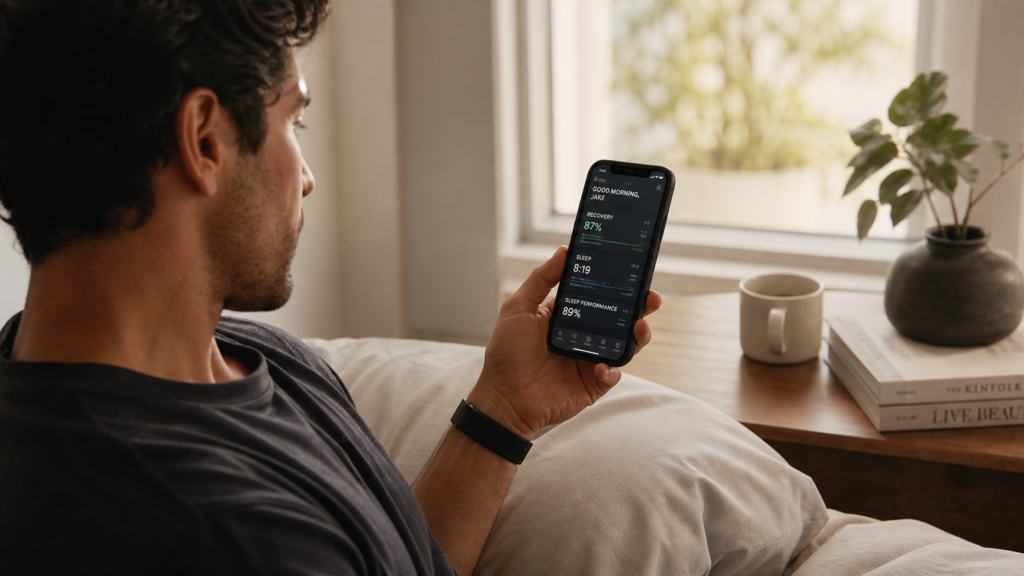
If you enjoy data, trend analysis, and incremental self-improvement, it can become part of your routine quickly. You wake up, check your recovery, assess your sleep need, and adjust your day. Over time, that creates a feedback loop that can meaningfully change how you train and recover.
If you are the opposite type of user, someone who hates opening apps, logging habits, or interpreting readiness scores, the value drops quickly. WHOOP is not a passive magic band. It works best when you actively use the recommendations.
The screen-free design helps. WHOOP is built to avoid pings and unnecessary interruptions, making it easier to wear around the clock. For athletes who already get enough noise from phones and smartwatches, that simplicity is a genuine advantage. If you like the idea of 24/7 recovery tracking without constant notifications, WHOOP is worth a closer look, especially through the trial option.
Value for Money
WHOOP’s value depends almost entirely on what kind of buyer you are.
If you hate subscriptions, WHOOP will feel expensive no matter how good the coaching is. Current annual pricing starts at $199 for One, $239 for Peak, and $359 for Life, with meaningful feature differences. One covers core fitness and recovery tracking; Peak adds Healthspan, Health Monitor, and Stress Monitor; Life adds WHOOP MG plus ECG, on-demand AFib detection, and Blood Pressure Insights in beta.
That pricing is easier to justify for athletes who use WHOOP daily and change behavior based on the data. If the platform helps you sleep better, reduce overtraining, manage stress, and train more consistently, the value can be real. If you only want occasional curiosity metrics, it is harder to defend.
For student athletes on a tighter budget, WHOOP is a tougher sell. For committed endurance athletes or professionals with higher disposable income, the value proposition is much stronger, especially if recovery quality is a chronic bottleneck.
One nice touch is the one-month free trial with a certified pre-owned WHOOP 5.0 device, which lowers the risk for first-time buyers. Check today’s WHOOP pricing and see current trial options:
WHOOP ONE: https://amzn.to/4n3pbRe
WHOOP PEAK: https://amzn.to/4tedIjx
WHOOP LIFE: https://amzn.to/4tM92lO
Value for Money
WHOOP is still one of the most distinctive wearables on the market because it is built less like a gadget and more like a coaching system.
Its biggest strengths are clear: excellent recovery insights, strong sleep guidance, meaningful long-term training context, and a user experience that pushes habit change instead of distraction. For endurance athletes, serious recreational athletes, and data-minded lifters, that can be genuinely valuable.
Its weaknesses are just as clear: no built-in GPS, no display, and a pricing model that only makes sense if you use the platform consistently.
So, is WHOOP worth it?
Yes, for athletes who want guidance more than gadgets. No, for buyers who mainly want smartwatch features or a one-time hardware purchase.
If your biggest challenges are stalled progress, poor recovery, and training without enough feedback from your body, WHOOP remains one of the better tools you can buy. But the best WHOOP plan isn’t necessarily the most expensive. For most performance-focused users, the real decision is whether One gives you enough, or whether Peak’s added features justify the extra spend.